Fast Customs Clearance
Quick and compliant clearance ensuring your shipments move without delays across major ports.
Transtake Shipping Solutions Pvt Ltd is a trusted logistics company in India, specializing in customs clearance, freight forwarding, and import-export services. We provide fast, reliable, and cost-effective shipping solutions across Mumbai, Delhi, Mundra, and Gujarat.
International shipping to India involves more than booking a container and arranging transportation. With the Sea Cargo Manifest and Transhipment Sea Cargo Manifest and Transhipment Regulations (SCMTR), accurate shipment and importer information plays an important role in the customs and manifest filing process.
For import shipments arriving in India by sea, shipping lines and other authorised stakeholders need accurate information to complete the required electronic declarations. ICEGATE continues to publish SCMTR message implementation guides and advisories for different stakeholders and message types.
To help avoid documentation issues and delays, importers should keep their business and shipment details accurate and readily available.
SCMTR stands for Sea Cargo Manifest and Transhipment Regulations. It provides the regulatory framework for electronic reporting of sea cargo information to Indian Customs.
SCMTR covers different cargo-related declarations and electronic messages associated with the movement of import, export and transhipment cargo. ICEGATE provides dedicated SCMTR guidance, registration information, FAQs and message implementation guides for the trade and logistics community.
The system is designed to improve the availability of cargo information before and during the movement of goods and support more efficient customs processing.
Incorrect or incomplete information can create problems during manifest filing, amendments, cargo processing and customs clearance.
For this reason, importers should coordinate with their shipping line, authorised sea agent, freight forwarder or customs clearance agent and provide the required information correctly.
The SCMTR framework uses electronic declarations submitted through the customs system, with message formats and validations specified through ICEGATE's Message Implementation Guidelines.
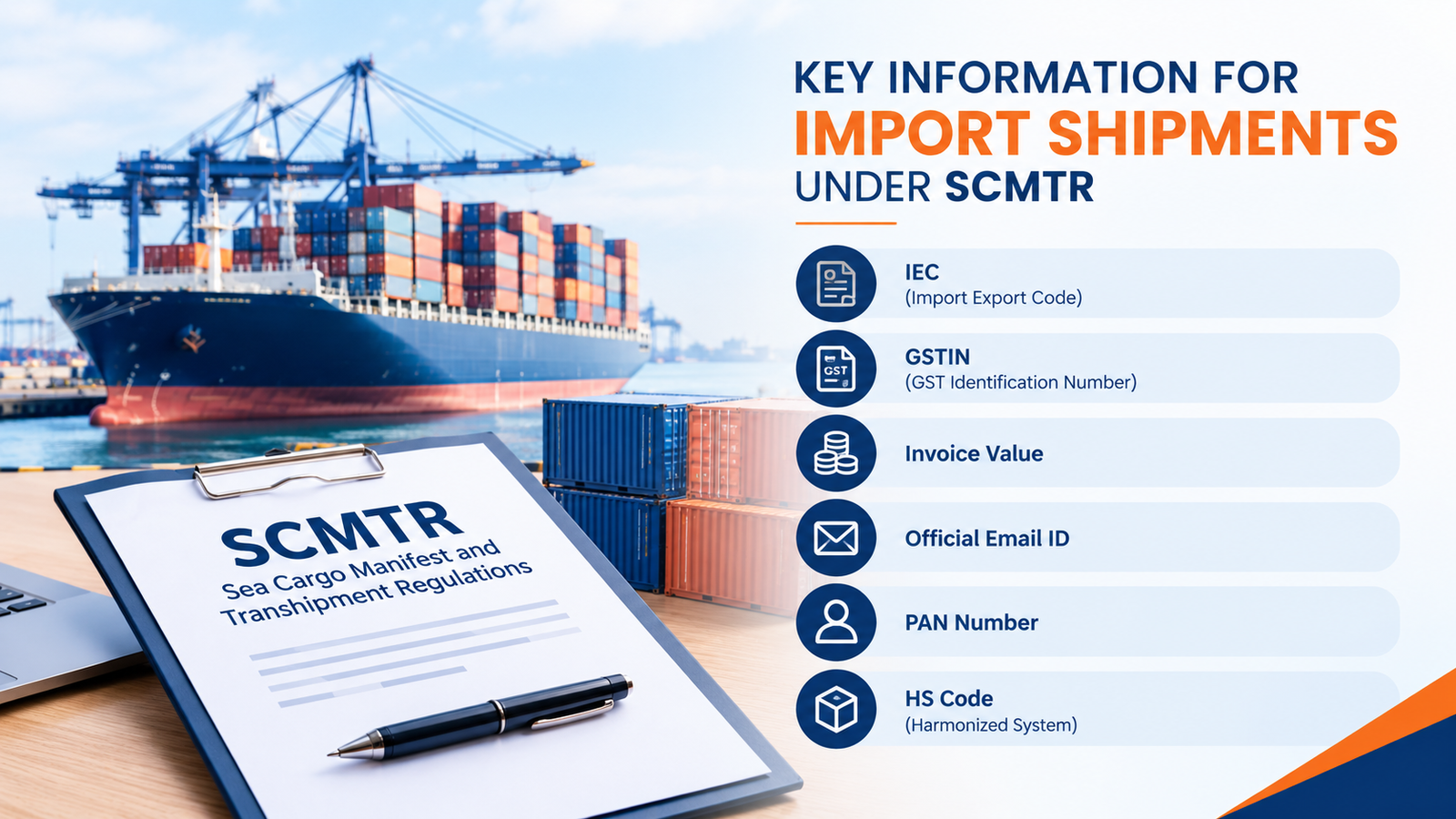
The information shown in the accompanying SCMTR awareness creative can be used as a practical checklist for importers.
The Import Export Code (IEC) of the importer is an important identification detail for international trade transactions in India.
Importers should ensure that the IEC shared with their shipping or logistics partner is correct and corresponds with their business records.
The importer's GST Identification Number (GSTIN) may be required as part of the relevant cargo and entity information.
It is important to provide the correct GSTIN because customs systems perform validations on submitted information. ICEGATE's SCMTR FAQ documentation specifically includes GSTIN-related validation checks.
The invoice value of the cargo is another important shipment detail.
Importers should ensure that the commercial invoice contains accurate information and that the cargo value communicated to the relevant logistics or shipping partner is consistent with the shipment documents.
Differences between documents can result in additional queries or the need for corrections.
Importers should provide an official and active email address for communication related to their shipment.
A reliable email ID helps shipping lines, customs representatives and logistics service providers communicate regarding documentation, shipment information, amendments and other requirements.
The importer's Permanent Account Number (PAN) is another important identification detail associated with customs and trade-related records.
Businesses should ensure that the PAN information provided to their logistics partners is accurate and matches the applicable business records.
ICEGATE's SCMTR documentation identifies PAN as one of the key terms used within the SCMTR framework.
The HS Code is used to classify goods for international trade and customs purposes.
Correct classification is particularly important because the HS classification can affect applicable customs duties, import policy requirements, documentation and regulatory checks.
Importers should therefore avoid guessing the HS code and should verify the appropriate classification for their products before shipment.
Incorrect information can lead to additional documentation requirements, amendments or communication with the shipping line and customs-related stakeholders.
For example, issues may arise when:
• IEC details do not match the importer
• GSTIN information is incorrect
• PAN details are inconsistent
• Cargo value differs between documents
• HS classification is incorrect
• Contact information is unavailable or outdated
• Shipment information does not match the supporting documents
ICEGATE's SCMTR system performs structural and data validations on submitted declarations and provides error information when validation requirements are not met.
A simple documentation check before shipment can reduce avoidable issues.
Maintain updated IEC, GSTIN, PAN and contact information and share the correct details with your shipping line, freight forwarder or customs clearance agent.
Make sure the commercial invoice, packing list and other shipment documents contain consistent information.
Product classification should be reviewed before the shipment is processed. An incorrect HS code can create customs compliance and duty-assessment issues.
Do not wait until the cargo reaches the Indian port to discover a documentation mismatch. Importers should coordinate with their logistics and customs partners in advance.
An experienced customs clearing and freight forwarding agent in Mumbai can coordinate with shipping lines, customs authorities, freight forwarders and transporters to help keep the import documentation process organised.
ICEGATE is the electronic interface used for customs-related filing and communication. SCMTR declarations are submitted electronically, and ICEGATE provides message formats, implementation guides, FAQs and advisories for the relevant stakeholders.
ICEGATE's current SCMTR resources also include updated Message Implementation Guides for authorised sea carriers and other stakeholders, demonstrating that technical filing requirements can be updated over time.
Therefore, importers and logistics professionals should refer to the latest applicable customs and ICEGATE guidance rather than relying only on older checklists.
TransTake Shipping Solutions Pvt Ltd provides customs clearing and freight forwarding support for businesses involved in international trade.
Our services include:
• Import customs clearance
• Export customs clearance
• Customs documentation
• HS code classification support
• Duty assessment coordination
• Sea freight forwarding
• Air freight forwarding
• Cargo handling
• Shipment tracking
• Transportation coordination
• Shipping line coordination
• Customs compliance support
From documentation coordination to customs clearance and transportation, our team helps importers manage the different stages of their shipment.
Accurate IEC, GSTIN, PAN, cargo value, contact information and HS classification can help importers maintain smoother documentation and customs coordination for sea shipments to India.
Before shipping, businesses should verify their details and coordinate with their logistics and customs partners to minimise avoidable delays.
TransTake Shipping Solutions Pvt Ltd can assist businesses with customs clearance, freight forwarding and import-export documentation across India.
Working Experience

 Why Choose Us
With strong industry experience, we deliver secure, timely, and compliant logistics solutions across Mumbai, Delhi, Mundra, and Gujarat.

Quick and compliant clearance ensuring your shipments move without delays across major ports.

From small consignments to full loads, we offer scalable logistics services tailored to your needs.

Complete support from pickup to delivery with proper documentation and real-time shipment handling.